

Printing Labels In-House or Outsourcing? — The True Cost Calculation Many Businesses Haven't Done
This is a question many purchasing departments and operations managers ask when label costs start to scale with production volume: "Instead of buying labels externally, why don't we buy a printer and print them ourselves?"
It is a valid question — and the answer is not as simple as "printing in-house is cheaper" or "outsourcing is better." The answer depends on the label type, volume, complexity level, and the operational capabilities of each business.
When Does In-House Printing Make Sense?
Simple labels with frequently changing content: Price tags, warehouse barcode labels, electronic scale labels, shipping waybills — these are labels that do not require complex colors, have constantly changing content, and need to be printed instantly at the point of use. Buying a thermal printer and thermal paper rolls to print on-site is the optimal solution for both speed and cost.
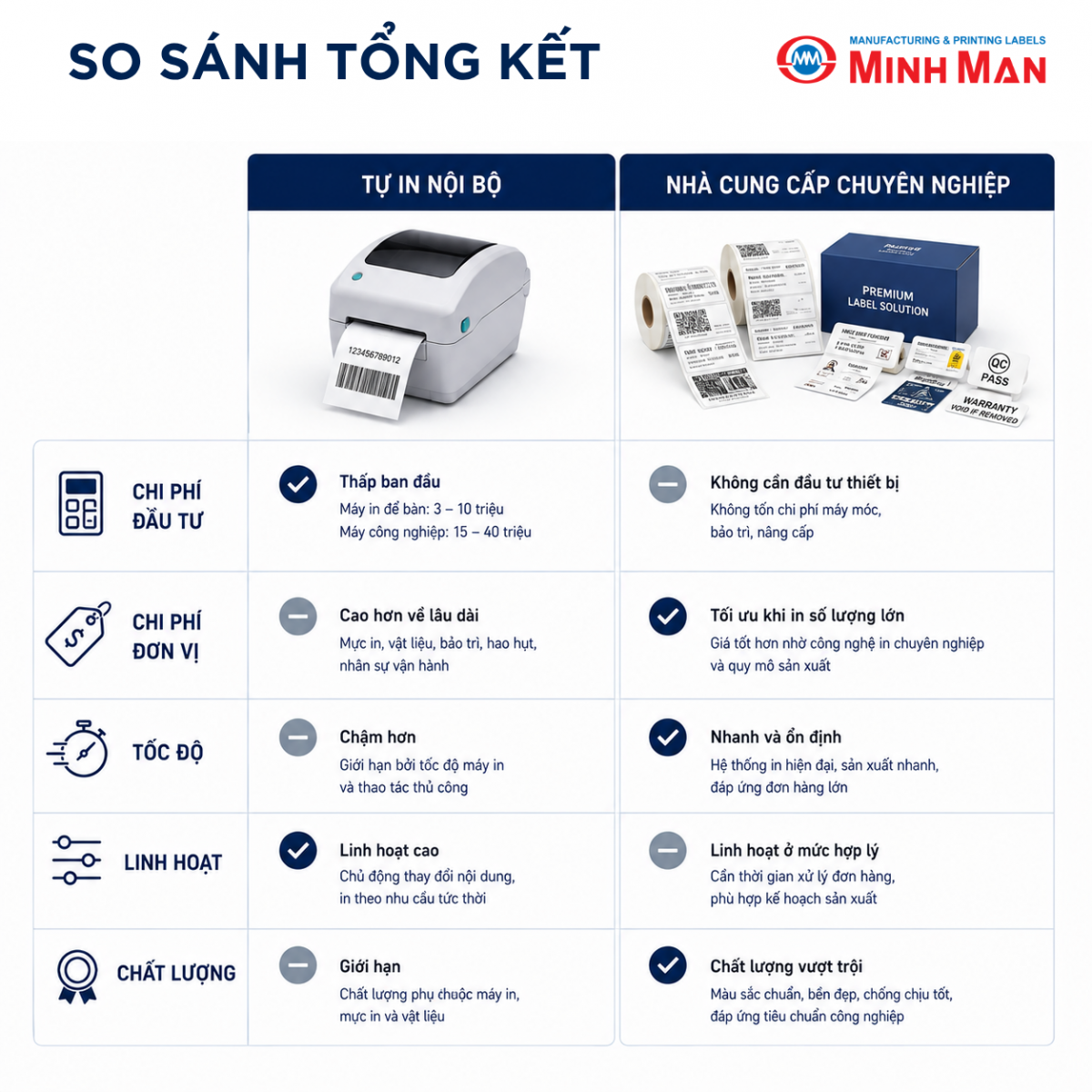
In-house setup costs: Desktop thermal printers (Zebra, TSC) range from 3–10 million VND. Industrial thermal printers range from 15–40 million VND. Consumables: only thermal paper rolls (direct thermal) or paper + ribbon (thermal transfer).
Clear ROI: If printing over 500–1,000 simple labels per day, investing in an in-house printer typically yields a return on investment (ROI) within 6–18 months, depending on machine and material costs.
Printing Labels In-House or Outsourcing? — The True Cost Calculation Many Businesses Haven't Done
This is a question many purchasing departments and operations managers ask when label costs start to scale with production volume: "Instead of buying labels externally, why don't we buy a printer and print them ourselves?"
It is a valid question — and the answer is not as simple as "printing in-house is cheaper" or "outsourcing is better." The answer depends on the label type, volume, complexity level, and the operational capabilities of each business.
.png)
When Does In-House Printing Make Sense?
Simple labels with frequently changing content: Price tags, warehouse barcode labels, electronic scale labels, shipping waybills — these are labels that do not require complex colors, have constantly changing content, and need to be printed instantly at the point of use. Buying a thermal printer and thermal paper rolls to print on-site is the optimal solution for both speed and cost.
In-house setup costs: Desktop thermal printers (Zebra, TSC) range from 3–10 million VND. Industrial thermal printers range from 15–40 million VND. Consumables: only thermal paper rolls (direct thermal) or paper + ribbon (thermal transfer).
Clear ROI: If printing over 500–1,000 simple labels per day, investing in an in-house printer typically yields a return on investment (ROI) within 6–18 months, depending on machine and material costs..png)
When is Outsourcing to a Professional Supplier Better?
Complex color labels and brand designs: Product labels for cosmetics, packaged foods, and pharmaceuticals with multiple colors, images, and special printing effects — these cannot be produced by office or thermal printers. They require professional printing equipment (flexo, offset, UV) worth billions of VND, demanding professional technicians and strict color control processes.
The hidden costs of in-house color printing: Dedicated color inkjet label printers range from 100–500 million VND. Operating technician: at least 1 dedicated staff member. Specialty materials (BOPP, aluminum, Polyester): must be purchased in large volumes as manufacturers do not sell retail. Maintenance costs, ink, periodic color calibration. Spoilage rates and reprints.
Actual economic efficiency: Most small and medium enterprises do not produce a sufficient volume of complex color labels to amortize the equipment costs within a reasonable timeframe — especially when factoring in personnel costs and the opportunity cost of machinery capital investment.
.png)
The Optimal Hybrid Model for Many Businesses
Many medium and large food and retail enterprises effectively apply a hybrid model:
Outsource: Product labels (color printing, brand designs, stable quantities based on production batches).
Print in-house: Warehouse barcode labels, variable price tags, electronic scale labels, shipping waybills (thermal printing, variable content, requiring instant printing).
This division optimizes costs for both categories: you avoid overpaying for simple labels when you can print them in-house, and you avoid investing in expensive equipment for complex labels when a supplier can do it better at a lower unit cost.
Minh Man Label — Consult and get a quote now via:


|







.png)
.png)
.png)
.png)

.png)
.png)
.png)
.png)