

In B2B procurement, many businesses choose to work with multiple label suppliers simultaneously.
One supplier specializes in specification labels.
One specializes in anti-counterfeit labels.
One produces epoxy logos.
Another handles POSM (Point of Sale Materials) or display items.
At first glance, this seems like a logical strategy. Every supplier has their own strength, businesses can easily compare prices, and it avoids over-reliance on a single partner.
However, as production scale increases, the number of SKUs multiplies, and product launch cycles shorten, this model often generates "hidden" costs that never appear on a quotation.
In many cases, the additional operational costs far outweigh the money saved by splitting orders.
In B2B procurement, many businesses choose to work with multiple label suppliers simultaneously.
One supplier specializes in specification labels.
One specializes in anti-counterfeit labels.
One produces epoxy logos.
Another handles POSM (Point of Sale Materials) or display items.
At first glance, this seems like a logical strategy. Every supplier has their own strength, businesses can easily compare prices, and it avoids over-reliance on a single partner.
However, as production scale increases, the number of SKUs multiplies, and product launch cycles shorten, this model often generates "hidden" costs that never appear on a quotation.
In many cases, the additional operational costs far outweigh the money saved by splitting orders.
.png)
When evaluating suppliers, most businesses focus on the unit price.
However, for manufacturing enterprises, the printing price is only a small fraction of the Total Cost of Ownership (TCO).
Factors that have a much greater impact include:
Delivery schedules;
Coordination capability between parties;
The consistency of the entire label system;
Response time when incidents occur.
A label suite for a modern product rarely consists of just one type.
For example, a single electronic device might simultaneously require:
A technical specification label;
A brand logo;
A warranty seal;
An anti-counterfeit label;
Instructional labels;
Decorative decals;
POSM for retail support.
If each item is produced by a different vendor, the business itself is forced to become the "central coordinator" among all parties.
.png)
Every printer uses:
Different color management systems;
Different equipment;
Different materials;
Different QC standards.
The result is that the exact same brand color can end up looking:
Darker on the product logo,
Lighter on the warranty seal,
And shifted to a completely different tone on the POSM.
The difference may seem minor, but when placed side-by-side on the same product or at the same point of sale, customers will easily notice.
For businesses building long-term brand equity, this is a risk that should not be taken lightly.
One of Minh Man Label’s core advantages is maintaining color stability through strict color management systems, QC processes, and cross-batch control standards.
.png)
An assembly line cannot afford to wait because one type of label is missing.
Yet, this happens quite frequently when a business uses multiple suppliers.
For example:
Spec labels are delivered;
Epoxy logos are unfinished;
Anti-counterfeit labels are waiting for finishing;
POSM is delayed by a week.
The result is:
The warehouse has to hold partial inventory;
Production must adjust schedules;
Marketing must delay the product launch;
Sales lack the materials to execute campaigns.
Even if each supplier eventually finishes their part, the entire project is still delayed.
.png)
This is the scenario that costs Purchasing and Supply Chain departments the most time.
For example:
The customer points out that the logo color and the label color do not match.
The logo supplier claims the label color is wrong.
The label supplier claims the logo doesn't meet the standard.
The business is stuck acting as the mediator, comparing proofs, and resolving the dispute.
Prolonging the determination of liability not only impacts the schedule but also drives up internal handling costs.
.png)
Every supplier means:
One quotation process;
One contract;
One point of contact;
One delivery schedule;
One acceptance process;
One set of payment documents.
The workload for the Purchasing team increases significantly, especially when a business manages hundreds of SKUs or frequently develops new products.
Instead of focusing on high-value activities, personnel spend vast amounts of time tracking and coordinating.
Another frequently overlooked expense is logistics.
Multiple suppliers mean:
Multiple shipments;
Multiple receiving inspections;
Multiple warehouse entries;
Multiple document processing steps.
Each individual cost might be small, but when aggregated over a month or a year, the total becomes substantial.
.png)
Not every business needs to work with just one supplier.
However, if your business has the following characteristics, consolidation is a highly worthwhile consideration:
Has multiple product lines.
Uses many different types of labels.
Frequently launches new products.
Requires consistent brand identity.
Needs tight schedule control.
Wants to reduce the administrative workload for Purchasing and Supply Chain.
In these cases, the benefit lies not just in reducing the number of suppliers, but in simplifying the entire coordination process.
Instead of just supplying one type of label, a partner with comprehensive capabilities can help a business build a synchronized label ecosystem.
At Minh Man Label, businesses can simultaneously deploy 5 core solution groups:
Specification labels
Machinery labels
Product labels
Warranty seals
Tamper-evident seals
Holograms
VOID labels
Scratch cards
Dynamic QR Codes
Product authentication solutions
Raised logos
Epoxy dome logos
Premium decorative details
Solutions for electronics, home appliances, and premium products
Window decals
Shelf talkers
Promotional labels
Point-of-sale support materials
Membrane switches
Control panels
Technical labels
Labels for electronic and industrial equipment
Minh Man Label’s orientation is not to be a "print shop that can do many types of labels," but to be an industrial label solution provider that helps businesses optimize operations, control risks, and maintain long-term stability.
.png)
For a manufacturing enterprise, a complete set of labels doesn’t just need to look good or meet technical specs.
More importantly, the entire process—from consulting, designing, material selection, and production technology to quality control—must be managed as a unified system. This is why Minh Man Label built a 5-step process that begins with understanding the customer's usage environment and operational goals, rather than just taking a file and hitting print.
When every item is executed within the same process, a business will significantly reduce:
Coordination time,
Color deviation risks,
Material inconsistencies,
Schedule delays,
And accountability disputes between suppliers.
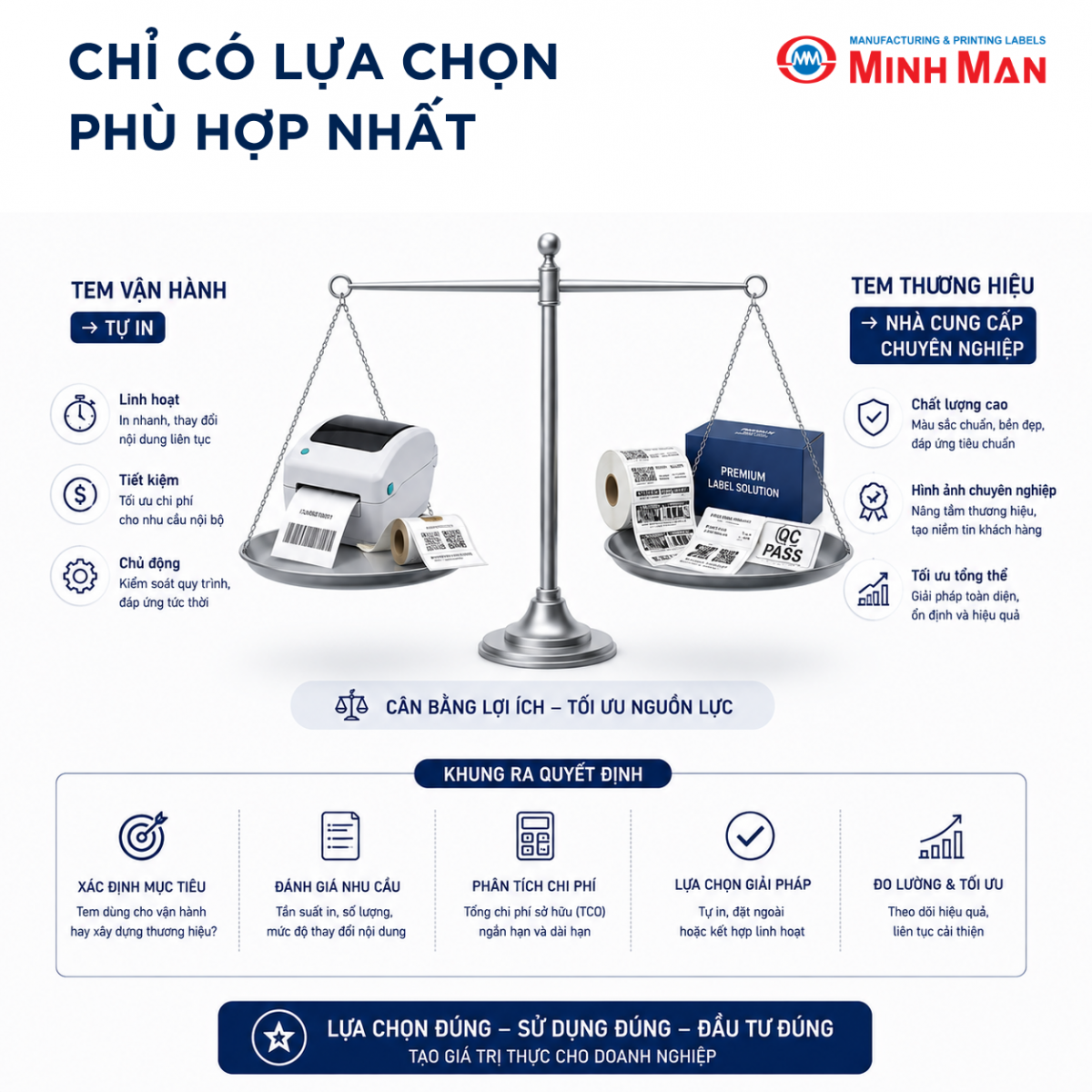
In modern manufacturing, labels are no longer isolated components but integral parts of the operational system.
Using multiple suppliers may offer advantages in certain situations, but it also inflates management costs, coordination efforts, and operational risks if there isn't a capable central point of contact.
For B2B enterprises, the goal is not just finding a place to print labels at a good price; it is finding a partner who can help the entire label system operate stably, cohesively, and with minimal risk throughout the product lifecycle. This is the exact positioning Minh Man Label pursues: providing not just labels, but solutions that help businesses "get it right from the start" and operate with the lowest possible risk.


|







.png)
.png)
.png)
.png)

.png)
.png)
.png)
.png)