

For years, barcodes have been the standard in warehouse management. With just a handheld scanner, businesses can track goods, conduct inventory counts, and trace product information relatively efficiently.
But as warehouse scales grow, inventory turnover speeds up, and automated systems like AGVs (Automated Guided Vehicles), ASRS (Automated Storage and Retrieval Systems), or WMS (Warehouse Management Systems) become prevalent, barcodes are beginning to reveal their inherent limitations.
That is when RFID (Radio Frequency Identification) becomes a critical technology in building a smart warehouse.
For years, barcodes have been the standard in warehouse management. With just a handheld scanner, businesses can track goods, conduct inventory counts, and trace product information relatively efficiently.
But as warehouse scales grow, inventory turnover speeds up, and automated systems like AGVs (Automated Guided Vehicles), ASRS (Automated Storage and Retrieval Systems), or WMS (Warehouse Management Systems) become prevalent, barcodes are beginning to reveal their inherent limitations.
That is when RFID (Radio Frequency Identification) becomes a critical technology in building a smart warehouse.
Barcodes operate on a very simple principle: the scanner must "see" the barcode (direct line of sight).
This means:
Every package must be positioned at the correct scanning angle;
Staff must scan each product individually;
The barcode must be clean, unobstructed, and undamaged;
Processing speed relies heavily on manual human operation.
In warehouses with a few hundred SKUs, this is perfectly acceptable.
But for logistics centers, e-commerce fulfillment hubs, or factories circulating tens of thousands of pallets a day, scanning individual barcodes becomes an operational "bottleneck."
RFID (Radio Frequency Identification) is a technology that uses radio waves for identification.
Each RFID label integrates:
A microchip to store data;
An antenna to communicate with the reader;
A protective material layer suited for the operating environment.
Unlike barcodes, RFID does not require a direct line of sight.
A reader can communicate with hundreds or thousands of RFID tags simultaneously via radio waves.
This creates a massive differentiator for automated systems.
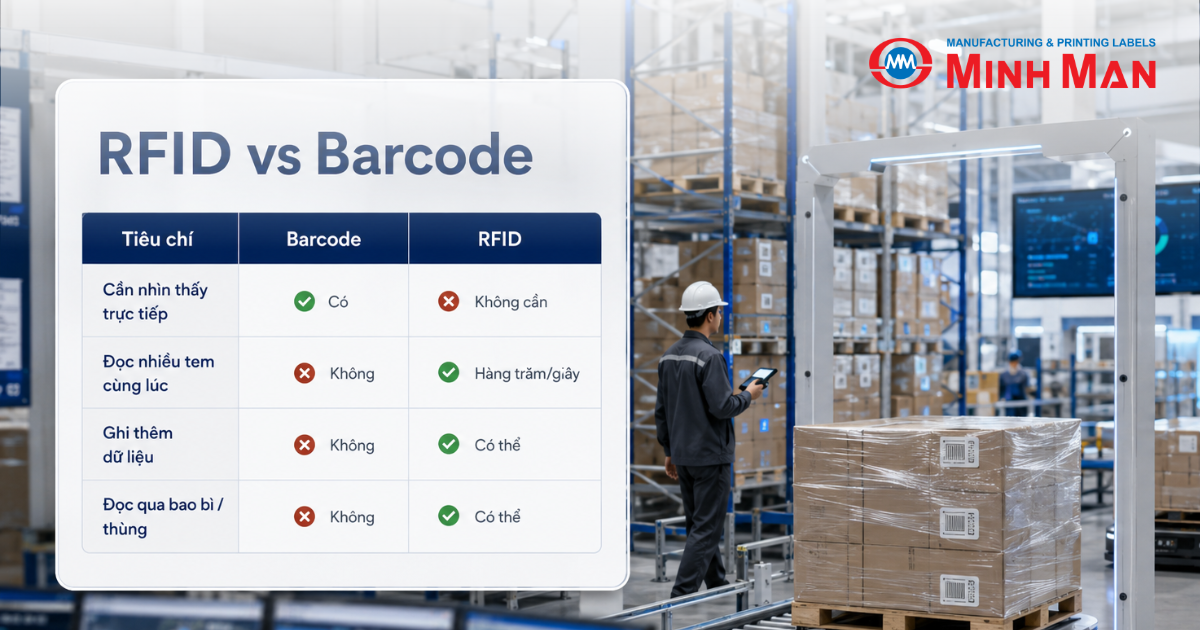
Barcodes remain an economical solution suitable for many businesses. However, when the goal is warehouse automation, RFID offers capabilities that barcodes simply cannot match.
In modern factories, AGVs are used to transport raw materials and finished goods between zones.
When pallets are equipped with RFID tags, AGVs can:
Identify pallets from a suitable distance;
Determine the exact storage location;
Verify the correct type of goods;
Confirm transport orders;
Navigate automatically to the destination.
This entire process happens without an employee using a barcode scanner.
This reduces errors and accelerates operations.
This is one of the most visible efficiency gains.
With barcodes, staff must:
Open every pallet;
Locate the barcode;
Scan every single product or carton.
Conversely, RFID allows staff to simply walk a reader down the aisles.
The reader captures all RFID signals within its range and automatically reconciles them with the warehouse management system.
Tasks that once took days can be reduced to just minutes or hours, depending on warehouse size and system configuration.
Another popular application is RFID portals at shipping and receiving docks.
When a truck or forklift drives through:
The system automatically identifies the entire pallet;
Cross-checks it against the delivery order;
Updates the WMS or ERP instantly;
Logs the exact entry/exit time.
No stopping to scan individual packages.
No need for multiple tally clerks.
No manual data entry.
This is highly beneficial for businesses with massive daily inbound and outbound traffic.
RFID is also utilized as a security control layer.
If a product passes through an RFID gate without a valid outbound order, the system can:
Trigger an alarm;
Log the timestamp;
Pinpoint the location;
Store data for traceability.
Real-time monitoring capabilities help businesses mitigate the risk of inventory shrinkage, especially for high-value goods.
Logistics and 3PL: Logistics centers must process thousands of pallets daily. RFID helps: accelerate inbound/outbound speeds; reduce inventory errors; enhance traceability.
E-commerce and Fulfillment: Massive order volumes demand incredibly high processing speeds. RFID supports: real-time location tracking; reducing search times; optimizing the packing process.
Modern Retail: Retail chains use RFID to: track in-store inventory; manage shelf stock; reduce shrinkage; shorten periodic inventory counts.
Pharmaceuticals: In the pharma sector, RFID supports: unit-level traceability; batch management; expiration date tracking; reducing distribution mix-ups.
Electronics and Components: Electronics factories often manage large quantities of high-value components. RFID helps: precisely control inbound/outbound flow; track components through each production stage; minimize loss; support traceability when product defects occur.
Many businesses still think of RFID simply as a "sticker with a chip."
In reality, the true value of RFID lies not in the chip itself, but in the connectivity between the label, the reader, the Warehouse Management System (WMS), ERP, MES, and automated equipment like AGVs or ASRS.
The RFID label becomes the identification point that allows every component in the system to "communicate" with each other in real-time.
This lays the foundation for Smart Warehouse and Smart Factory models, where data is continuously updated without relying on manual tasks.
With RFID, the challenge isn't just printing a label and embedding a chip.
Businesses must also correctly choose:
The right RFID chip for the intended application;
The operating frequency (LF, HF, or UHF);
Label materials suited to the operating environment;
Adhesives compatible with metal, plastic, or cardboard surfaces;
A label structure that ensures stable readability throughout the product's lifecycle.
This is why RFID must be approached as a technical solution, not just a printed product.
At Minh Man Label, the consulting process always begins with analyzing the operating environment, materials, traceability requirements, and integration capabilities with the enterprise's management systems before proposing the appropriate label structure. This approach mitigates implementation risks and ensures RFID labels function stably in real-world conditions.
Barcodes will continue to be an effective solution for many businesses due to their low cost and ease of deployment. However, when the goal is warehouse automation, accelerated processing speeds, and building a smart factory, RFID delivers capabilities that go far beyond basic product identification.
An RFID label doesn't just store data. It is the "connection point" between physical goods and the entire operating system, helping businesses move closer to a smart manufacturing and logistics model, where data is updated in real-time and processes are automated at scale.


|







.png)
.png)
.png)
.png)

.png)
.png)
.png)
.png)