

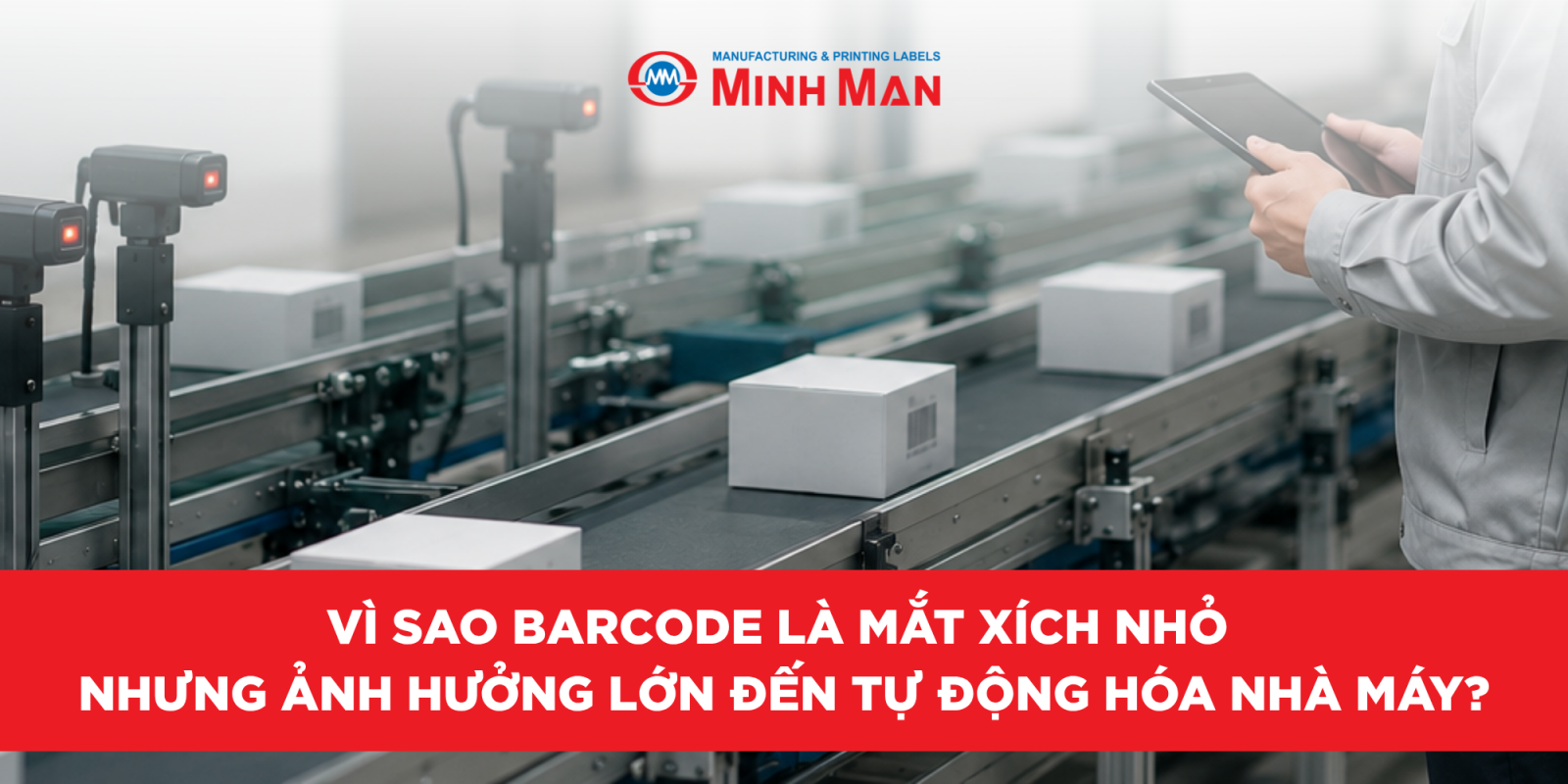
A business invests tens, even hundreds of billions of VND into automation systems: conveyors, sorting robots, smart warehouses, AGVs, MES, ERP...
But ultimately, the entire line might have to stop just because of a substandard barcode label.
It sounds unbelievable.
However, for factories that have implemented automation, this is not an uncommon scenario.
Because in a modern manufacturing environment, a barcode is no longer merely information printed on packaging. It is the "language" through which the entire machinery system communicates.
'
A business invests tens, even hundreds of billions of VND into automation systems: conveyors, sorting robots, smart warehouses, AGVs, MES, ERP...
But ultimately, the entire line might have to stop just because of a substandard barcode label.
It sounds unbelievable.
However, for factories that have implemented automation, this is not an uncommon scenario.
Because in a modern manufacturing environment, a barcode is no longer merely information printed on packaging. It is the "language" through which the entire machinery system communicates.
.png)
Previously, barcodes mainly served warehouse staff or sales personnel.
The scanner read the code.
A human verified the information.
If a scan failed, the staff could try a few more times.
But in an automated factory, the barcode reader is no longer human.
It is:
Industrial robots;
Automated conveyors;
High-speed sorters;
AGVs (Automated Guided Vehicles);
ASRS systems;
Vision cameras;
Fixed scanners on the assembly line.
These devices cannot "guess" a barcode.
They only have two states:
Readable;
Or unreadable.
There is no room for the flexibility of human operation.
In a modern factory, almost every activity begins with product identification.
The barcode is the starting point of that process.
For example:
When a product passes the reader:
The barcode is scanned;
The system identifies the product type;
It decides the next direction of movement.
If the barcode is unreadable, the conveyor doesn't know where to send the product.
Robots do not recognize products by sight.
They recognize them by data.
After reading the barcode, the robot knows:
Which order the product belongs to;
Which pallet to place it on;
Which zone to transfer it to.
A wrong barcode means the robot performs the wrong action.
Every time a barcode is scanned, data is immediately updated into the management system.
Information such as:
Production status;
Goods location;
Inventory quantity;
Order progress;
Traceability history...
...are all synchronized in real-time.
If the barcode is unreadable, the entire data chain behind it is disrupted.
At the final stage, barcodes help the system:
Confirm the correct order;
Verify the correct product;
Log the dispatch time;
Synchronize with ERP and WMS.
Just one incorrect barcode can force an entire batch to be manually re-inspected.
.png)
Many people think a barcode simply needs to be "visible."
The reality is completely different.
A barcode that looks fine to the human eye may not meet the requirements of an industrial scanner.
Here are the most common errors:
This is a very common error.
Causes can include:
Unstable printers;
Incompatible materials;
Substandard ink;
Poor finishing quality.
The consequences are:
Scanners must read multiple times;
Conveyor speed drops;
The line stops for manual processing.
If this repeats continuously, overall system efficiency drops significantly.
Barcodes cannot be scaled up or down arbitrarily.
Parameters such as:
Bar width;
Distance between bars;
Magnification ratio;
Quiet Zone (the blank space around the barcode)...
...must all adhere to strict standards.
If the quiet zone around the barcode is missing by just a few millimeters, the reader may not identify it accurately. In a high-speed environment, the error rate will skyrocket.
Many businesses only test barcodes right after printing.
But the more important question is:
Will the barcode still be readable three months later?
In real-world environments, labels may endure:
High humidity;
Cold storage;
Extreme heat;
Grease and oils;
Chemicals;
UV rays;
Friction during transport.
If the wrong material or protective coating is chosen, the barcode will:
Fade;
Scratch;
Lose contrast;
Become unscannable.
At that point, the problem is not the scanner, but the label itself.
This is why selecting the right material for the operating environment is always a crucial step in Minh Man Label’s consulting process.
For barcodes to operate stably on automated lines, businesses don't just need to "print it right."
They must control quality according to international standards.
This is a widely used barcode quality evaluation standard in the industry.
Barcodes are graded from A to F based on criteria such as:
Contrast;
Sharpness;
Dimensional tolerance;
Decodability.
For automated lines, many businesses aim for Grade A or Grade B to ensure stable readability.
The Quiet Zone is the blank space surrounding the barcode.
This area helps the reader determine the start and end points of the code.
If this blank space is encroached upon by:
Logos;
Borders;
Images;
Text...
...readability drops significantly. A seemingly "unimportant" blank space is actually the deciding factor in whether a scanner can accurately identify the code.
Scanners do not read colors.
They read the difference between light and dark areas.
If:
The ink is too faint;
The material is highly reflective;
The background and the code are too similar in color...
...the reader will take much longer to identify it, or fail to decode it altogether. High contrast is a prerequisite for stable, long-term system operation.
When deploying a Smart Factory, businesses often focus on:
Robots;
MES software;
ERP;
AGVs;
Automated warehouses.
Meanwhile, barcodes are viewed as a minor item.
In reality, this is the very link that connects physical products to data systems.
If this link is unstable, the entire automation chain is affected.
A state-of-the-art robot cannot make a decision if the input data is wrong.
An MES system cannot update accurately if the barcode isn't read.
A smart warehouse cannot operate efficiently if goods identification constantly encounters errors.
For many businesses, label evaluation criteria often stop at aesthetics: beautiful colors, sharp printing, correct design.
However, in a modern manufacturing environment, that is merely a prerequisite.
A standard-compliant barcode must maintain stable scannability from the moment the product leaves the assembly line, through storage and transit, all the way to the customer. This requires a combination of compliant design, suitable materials, precise printing technology, and strict quality control processes.
That is why Minh Man Label does not position itself as a "receive a file and hit print" unit, but as an industrial label solution provider. Our process begins with consulting on the usage environment, selecting materials, verifying manufacturability, and optimizing quality to mitigate long-term operational risks.
In an automated factory, a barcode may only take up a few square centimeters on a product, but it is the "touchpoint" of the entire operational system. Just a minor deviation in size, print quality, or material can disrupt data flows, reduce efficiency, and incur unexpected costs.
Investing in a standard-compliant barcode label is not an investment in a sticker; it is an investment in the stability of the entire production line.


|







.png)
.png)
.png)
.png)
.png)
.png)
.png)
.png)